

Background to the Conflict: Rising Tensions with Philip IV (1294–129 6)
Upon his election in 1294, Boniface VIII inherited a papacy weakened by internal disputes but sought to reassert its universal authority amid the growing centralisation of European monarchies.
-
Political Climate: Boniface ascended the throne following the unusual resignation of Celestine V, leading to rumours regarding the legitimacy of his election that his rivals, such as the Colonna family, would later exploit.
-
The Catalyst: The spark ignited in 1296 when King Philip IV of France, locked in costly wars with England and Flanders, imposed heavy taxes on French clergy to fund his campaigns—defying traditional Church exemptions.
-
Centralisation vs. Universality: Philip IV’s actions represented the birth of the modern nation-state, where the king sought total control over all subjects, including the clergy, within his borders.
Papal Response: Clericis Laicos and the Taxation Ban (1296)
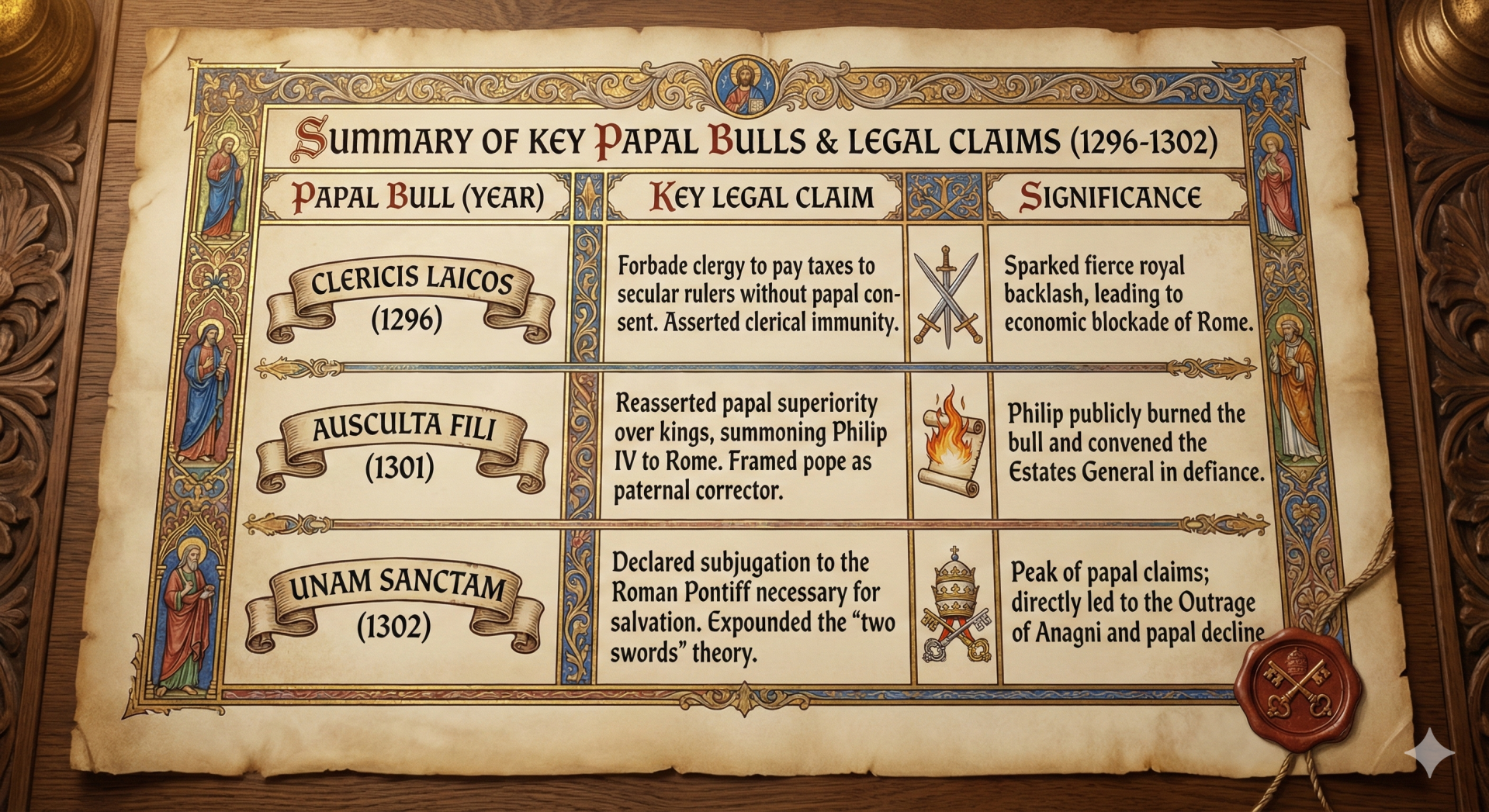
Viewing this as an assault on ecclesiastical rights, Boniface issued the bull Clericis laicos, forbidding clergy from paying taxes to secular rulers without papal consent and threatening excommunication for violators.
-
Ecclesiastical Immunity: The bull emphasised the Church's independence, asserting that the laity had no jurisdiction over the persons or property of the clergy.
-
Royal Backlash: It provoked a fierce royal backlash as Philip IV viewed this as a direct threat to his sovereignty and his ability to defend France.
-
The Doctrine of Two Swords: This move was an early application of the theory that the Church’s spiritual authority naturally commanded its material assets, free from secular interference.
Philip's Economic Retaliation and Boniface's Retreat (1296–1297)
Philip countered with a decree banning the export of gold, silver, precious stones, and food from France—severing a vital revenue stream for the papacy.
-
Financial Warfare: By stopping the flow of French currency to Rome, Philip effectively placed the papacy under an economic blockade.
-
Papal Capitulation: Facing a financial crisis, Boniface capitulated: he clarified the bull allowed taxes in cases of "dire need" (letting kings define necessity).
-
Mending Relations: To further ease tensions, Boniface canonised Philip's grandfather Louis IX as Saint Louis in 1297, a significant diplomatic gesture intended to honour the French royal line.
Renewed Clash: The Arrest of Bishop Saisset (1301)
Tensions reignited when Philip arrested Bernard Saisset, Bishop of Pamiers and a papal legate, on charges of treason and heresy—violating canon law's clerical immunity from civil trials.
-
The Insult to Rome: Saisset was a known critic of Philip, and his arrest in a secular court was seen as a deliberate provocation against papal authority.
-
Legal Conflict: Philip’s lawyers argued that "the king is emperor in his own kingdom," claiming jurisdiction even over high-ranking Church officials.
Boniface's Demand and Ausculta Fili (1301–1302)
Boniface demanded Saisset's release and summoned Philip to Rome for judgement, issuing the bull Ausculta fili ("Listen, my son") to reassert papal superiority over kings.
-
Paternal Correction: The title itself was a play on the opening of the Rule of Saint Benedict, framing the Pope as a father correcting an errant son.
-
Escalation: Philip escalated the situation; he publicly burnt the bull and convened the first Estates General (1302).
-
National Unity: By rallying nobles, clergy, and commoners in national defiance, Philip portrayed Boniface as an overreaching tyrant and successfully gathered the French people behind the crown.
The Issuance of Unam Sanctam: Peak of Papal Claims (November 18, 130 2)
In direct response to Philip's challenge, Boniface promulgated Unam Sanctam, declaring there is "one holy Catholic and apostolic Church" outside which there is no salvation.
-
The Two Swords Theory: The bull expounded the "two swords" theory: both spiritual (Church) and temporal (kings) authority belong to the pope, with secular rulers subject to spiritual power.
-
Hierarchical Order: Boniface argued that the spiritual power must establish the earthly power and pass judgement on it if it is not good.
-
The Dogmatic Assertion: The document climaxed with the dogmatic assertion: "We declare, we proclaim, we define that it is absolutely necessary for salvation that every human creature be subject to the Roman Pontiff"—the most extreme claim of papal supremacy in history.
Immediate Aftermath: Philip's Defiance and the Outrage of Anagni (1303)
Philip rejected the bull, accusing Boniface of heresy, simony, and immorality; he dispatched lawyer William of Nogaret to depose the pope.
-
The Plot: Nogaret joined forces with the Colonna family (Boniface's Italian rivals) to plan a physical strike against the Pope.
-
The Attack: On September 13, 1303, Nogaret and the Colonna family stormed the papal palace at Anagni.
-
The Assault: They slapped and imprisoned the elderly pope for days amid physical and verbal abuse—the infamous "Outrage of Anagni".
-
Symbolic Defeat: The "Slap of Anagni" (traditionally attributed to Sciarra Colonna) became the enduring symbol of the transition from the mediaeval to the early modern era.
Boniface's Death and Papal Decline (October 1303 Onward)
Rescued by Anagni townspeople, Boniface returned to Rome but died a month later from shock and humiliation.
-
Power Vacuum: His death marked the beginning of a rapid decline in the independent political power of the papacy.
-
The Avignon Papacy: His successor, Clement V (French), relocated the papacy to Avignon (1309–1377).
-
The Babylonian Captivity: This era was known as the "Babylonian Captivity", where French influence dominated and the papacy was seen as a tool of the French crown.
-
The Great Schism: The Great Schism (1378–1417) followed, with rival popes dividing Europe—signalling the end of mediaeval papal dominance over national monarchies.
-
Shift in Sovereignty: The conflict proved that national loyalty and the power of the king had finally surpassed the universal claims of the Pope in European politics.
Add comment
Comments