

Protestant Reformation Timeline
I. Pre-Reformation: Seeds of Renewal (1300s–151 6) The "Morning Stars" of the Reformation and reform movements challenged papal authority and clerical corruption and promoted Scripture access before Luther.
- 1309–1377: Babylonian Captivity of the Papacy—Papal court relocated to Avignon, France; seen as a French political tool, severely undermining the papacy’s spiritual prestige.
- c. 1320–1384: Ministry of John Wycliffe (England)—Known as the “Morning Star of the Reformation”; challenged papal supremacy, rejected transubstantiation, and supervised the first complete English Bible translation. His Lollard followers continued underground.
- 1378–1417: The Great Schism—Rival popes in Rome and Avignon split European loyalties, intensifying calls for church reform.
- 1415: Execution of Jan Hus (Bohemia)—Czech reformer (c. 1369–1415), heavily influenced by Wycliffe, preached in the vernacular against indulgences, simony, and clerical abuses, and advocated Utraquism (communion in both kinds). Summoned to the Council of Constance under Emperor Sigismund’s safe-conduct promise, he was tried for heresy (over 260 articles), refused to recant unless proven wrong by Scripture, and was burnt at the stake on July 6, 1415. His martyrdom inspired the Hussite Wars (1419–1434) and was later hailed as a Reformation forerunner.
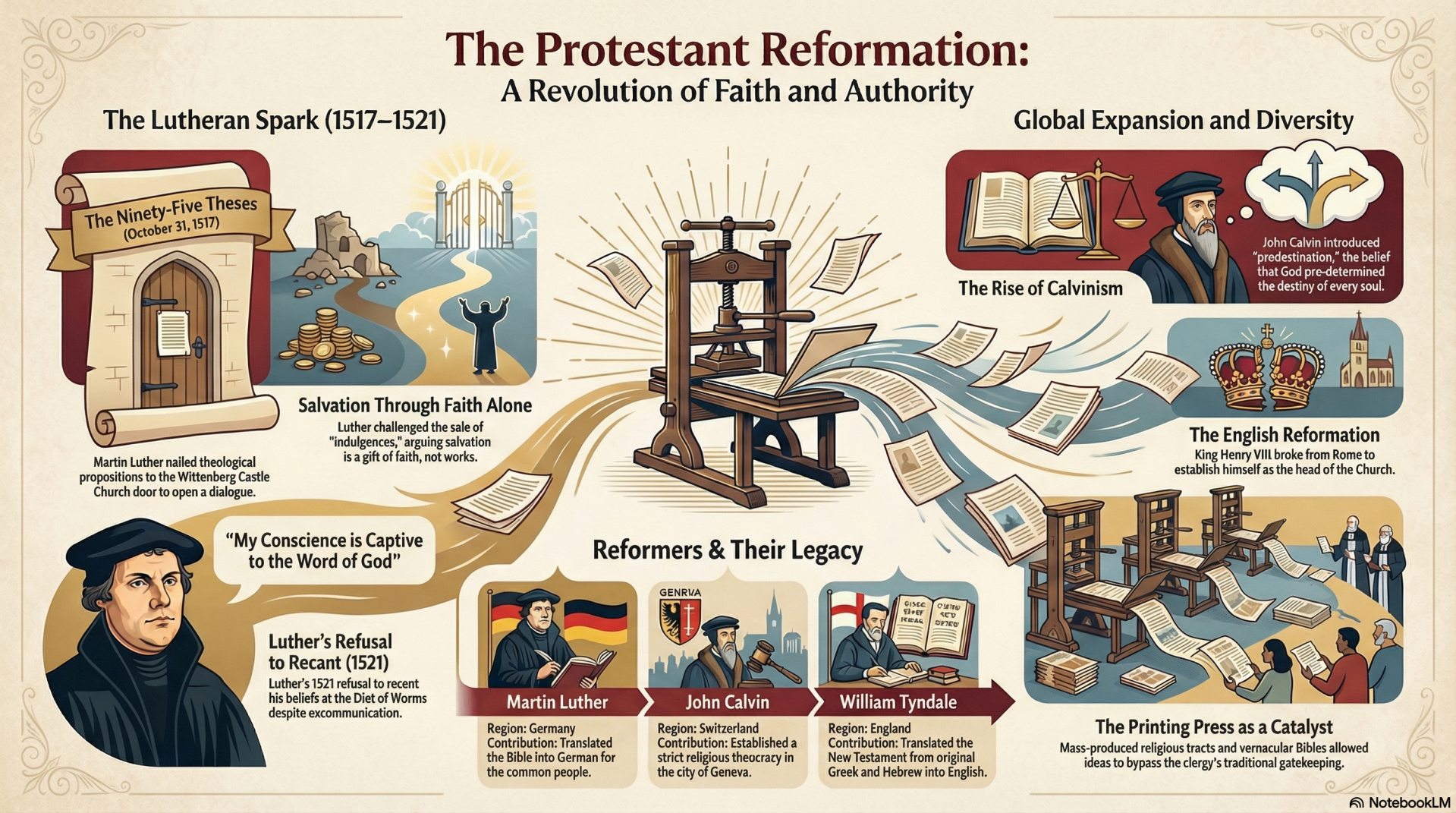
- 1450s: Gutenberg’s Printing Press—Movable-type press invented by Johann Gutenberg; dramatically lowered book costs and enabled rapid spread of the Bible and reform ideas.
- 1498: Execution of Savonarola—Dominican friar in Florence demanded moral reform and defied Pope Alexander VI; hanged and burnt. Luther later viewed him as a precursor.
- 1516: Erasmus Publishes Greek New Testament—Humanist Desiderius Erasmus’s critical edition exposed Vulgate errors and supplied the text for Luther’s and Tyndale’s vernacular Bibles.
II. The Lutheran Reformation (1517–1530) One monk’s protest ignited a theological, political, and social revolution.
- 1517: Luther Posts the 95 Theses—On October 31, Martin Luther nailed his protest against Johann Tetzel’s indulgence sales to the Castle Church door in Wittenberg—traditionally the spark of the Reformation.
- 1519: Leipzig Debate—Luther debated Johann Eck and asserted that popes and councils can err while Scripture is the supreme authority. Simultaneously, Huldrych Zwingli began biblical preaching in Zurich, launching the Swiss Reformation.
- 1520: Luther’s Key Treatises & Excommunication—Luther published three seminal works (Address to the Christian Nobility, The Babylonian Captivity of the Church, and On the Freedom of a Christian). Pope Leo X issued a condemnation bull; Luther burnt it and canon law books in Wittenberg.
- 1521: Diet of Worms—Summoned by Emperor Charles V, Luther refused to recant (“Here I stand, I can do no other”). Declared an outlaw; hidden at Wartburg Castle.
- 1522: Luther’s German New Testament—He completed his translation while in hiding, making Scripture accessible to ordinary Germans.
- 1525: The Peasants’ War—German peasants invoked Luther’s “freedom” rhetoric against serfdom; Luther condemned the uprising in Against the Murdering and Thieving Hordes of Peasants and urged princes to crush it, alienating many commoners.
- 1529: Diet of Speyer—Lutheran princes formally “protested” imperial religious bans—origin of the term "Protestant".
- 1529: Marburg Colloquy—failed attempt to unite Luther and Zwingli over the Lord’s Supper (Luther’s “Real Presence” vs. Zwingli’s memorial view).
- 1530: Augsburg Confession—Philip Melanchthon’s statement of Lutheran beliefs; rejected by the Emperor, formalising the Catholic-Protestant split.
III. Expansion and Fragmentation (1531–1560) The movement diversified into Lutheran, Reformed, Anglican, and Radical branches while spreading across Europe.
- 1531: Death of Zwingli—Killed in battle at Kappel while defending Protestant Zurich against Catholic Swiss cantons.
- 1531: Schmalkaldic League—Lutheran princes formed a defensive military alliance against possible imperial attack.
- 1534: Act of Supremacy (England)—Henry VIII declared himself Supreme Head of the Church of England, initiating the English (largely political) Reformation.
- 1534: Münster Rebellion (Radical Reformation)—Extreme Anabaptists seized the city, proclaimed the end times, and practised polygamy; they were brutally crushed, discrediting radical groups.
- 1536: Calvin’s Institutes & Tyndale’s Martyrdom—John Calvin published his systematic Institutes of the Christian Religion; William Tyndale, pioneer English Bible translator from original languages, was burnt at the stake—his work shaped the later King James Version.
- 1541: Calvin Reforms Geneva—Established a disciplined Reformed theocracy that influenced France (Huguenots), Scotland, and the Netherlands.
- 1545–1563: Council of Trent—Catholic Church’s response (Counter-Reformation); clarified doctrine, condemned Protestant teachings, reformed abuses, and strengthened papal authority.
- 1546: Death of Martin Luther—Died in Eisleben; leadership passed to Melanchthon.
- 1546–1547: Schmalkaldic War—Emperor Charles V defeated the Protestant league at Mühlberg, but gains were later reversed.
- 1547–1553: Reign of Edward VI (England)—Under Archbishop Thomas Cranmer, England moved decisively Protestant with the Book of Common Prayer (1549/1552).
- 1553–1558: Reign of “Bloody” Mary I—Restored Catholicism; nearly 300 Protestants burnt, including Cranmer, Ridley, and Latimer.
- 1555: Peace of Augsburg—Legalised Lutheranism in the Holy Roman Empire under cuius regio, eius religio (“whose realm, his religion”); princes chose the faith for their territories, with dissenters allowed to emigrate. Provided temporary stability but excluded Calvinists and others (see detailed impact below).
- 1559: John Knox in Scotland—Led Parliament to abolish papal authority and the Mass, founding the Presbyterian (Reformed) Church of Scotland.
- 1559: Elizabethan Settlement—Queen Elizabeth I established the Church of England as a Protestant “via media”—Reformed doctrine with some traditional elements, later provoking Puritan dissatisfaction.
IV. Post-Reformation: War and Orthodoxy (1560–1648) Doctrines solidified; religious divisions fuelled devastating European wars.
- 1560–1598: French Wars of Religion—Catholics vs. Huguenots (French Calvinists); St Bartholomew’s Day Massacre (1572) killed thousands; ended with the Edict of Nantes (1598) granting limited Huguenot tolerance.
- 1611: The King James Version—Authorised English Bible was published, largely based on Tyndale’s translation.
- 1618–1648: Thirty Years’ War—Began with the Defenestration of Prague as a Catholic-Protestant conflict; evolved into a Europe-wide political struggle causing massive devastation.
- 1648: Peace of Westphalia—Ended the war, legally recognised Calvinism alongside Catholicism and Lutheranism, redrew European borders, and effectively concluded the era of major Reformation-era religious wars.
Add comment
Comments