

Luther’s Point of No Return: The Making of a Revolutionary
By 1520, the bridge between Martin Luther and Rome had been detonated. What began as a local dispute over indulgences had evolved into a full-scale assault on the foundations of the mediaeval world. This is the story of how Luther prepared for the ultimate battle of conscience.
I. The Year of the Manifesto (1520)
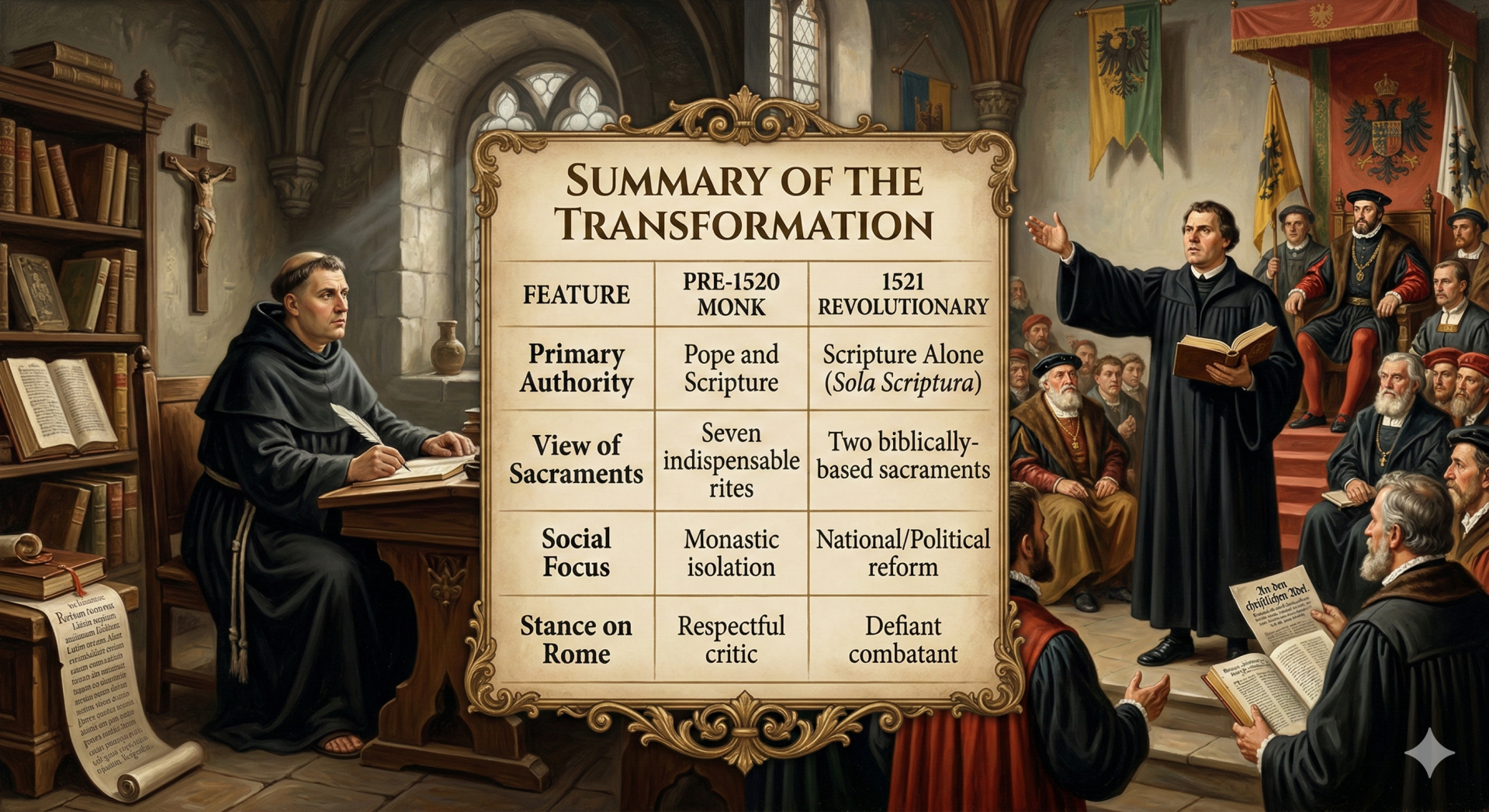
In a single year, Luther published three seminal treatises that effectively dismantled the theological monopoly of the Roman Church. These were declarations of independence for the German soul.
1. Address to the Christian Nobility of the German Nation
-
Attacking the "Three Walls": Luther criticised Rome’s claim that spiritual power is superior to secular rulers, that only the Pope can interpret Scripture, and that only the Pope can call a council.
-
The Priesthood of All Believers: He argued that every baptised Christian has the same spiritual status, stripping the clergy of their "magical" caste system.
-
Political Strategy: By appealing to German princes, Luther invited secular power into church reform, shifting authority from the pope to local rulers.
2. The Babylonian Captivity of the Church
The title of this work compared the 16th-century Church to the biblical exile of Israel in Babylon. Luther argued the "true" Gospel was being held hostage by Rome through three "chains":
-
The Captivity of the Cup: Luther condemned the practice of withholding the sacramental wine from the laity, insisting that Christ commanded "all" to drink of it.
-
The Captivity of Transubstantiation: He rejected the Aristotelian "philosophy" that the bread and wine literally change substance, calling it a mandatory intellectual trap.
-
The Captivity of the Mass as a "Work": Most critically, he rejected the idea that the Mass was a sacrifice offered by a priest to God. He insisted it was a gift of grace from God to man.
-
The Sacramental Reduction: He slashed the number of sacraments from seven to two: Baptism and the Lord’s Supper.
-
Rejected as Sacraments: Confirmation, Penance, Marriage, Ordination, and Extreme Unction.
-
3. The Freedom of a Christian
-
The Central Paradox: "A Christian is a perfectly free lord of all, subject to none. A Christian is a perfectly dutiful servant of all, subject to all."
-
Faith Over Works: Luther articulated that justification comes through faith alone. Good works flow naturally from a saved heart; they do not produce salvation.
-
Theological Heart: This became the foundational doctrine of the Protestant movement.
II. The Symbolic Incineration of Authority
-
Papal Bull Exsurge Domine: Rome condemned Luther’s teachings and demanded he recant under threat of excommunication.
-
The Bonfire of Defiance: On December 10, 1520, Luther publicly burnt the papal bull and books of canon law.
-
The Psychological Break: This act rejected Rome’s authority entirely and made reconciliation nearly impossible.
III. The Diet of Worms: Preparation for Battle
The conflict shifted from the pulpit to the palace as Emperor Charles V summoned Luther to the imperial assembly in 1521.
-
The Shadow of Jan Hus: Luther knew the historical danger; a century earlier, the reformer Jan Hus was promised "safe conduct" only to be executed.
-
Frederick the Wise’s Protection: Luther’s survival depended on the Elector of Saxony, who insisted on a fair hearing and enforced the "safe conduct" guarantee.
-
Individual Conscience: Luther prepared to defend his views based on a conscience "bound to the Word of God," prioritising the authority of Scripture over institutional power.
IV. Conclusion: The Irreversibility of Reform
By the end of this phase, Luther was fully prepared for battle:
-
Theologically Armed: With an articulated rejection of sacramental Catholicism.
-
Politically Supported: With German nationalism rising and princes acting as shields.
-
Spiritually Resolved: Moving from academic debate to a doctrinal revolution.
-
The Final Step: The stage was set for the direct confrontation with Emperor Charles V at the Diet of Worms.
all information is summarised from this book
The Reformation: A Captivating Guide to the Religious Revolution Sparked by Martin Luther and Its Impact on Christianity and the Western Church
Add comment
Comments