

The Establishment, Operation, and Impact of the Holy Office (Inquisition) in the Thirteenth Century
The Formation of a Centralized System for the Suppression of Heresy
-
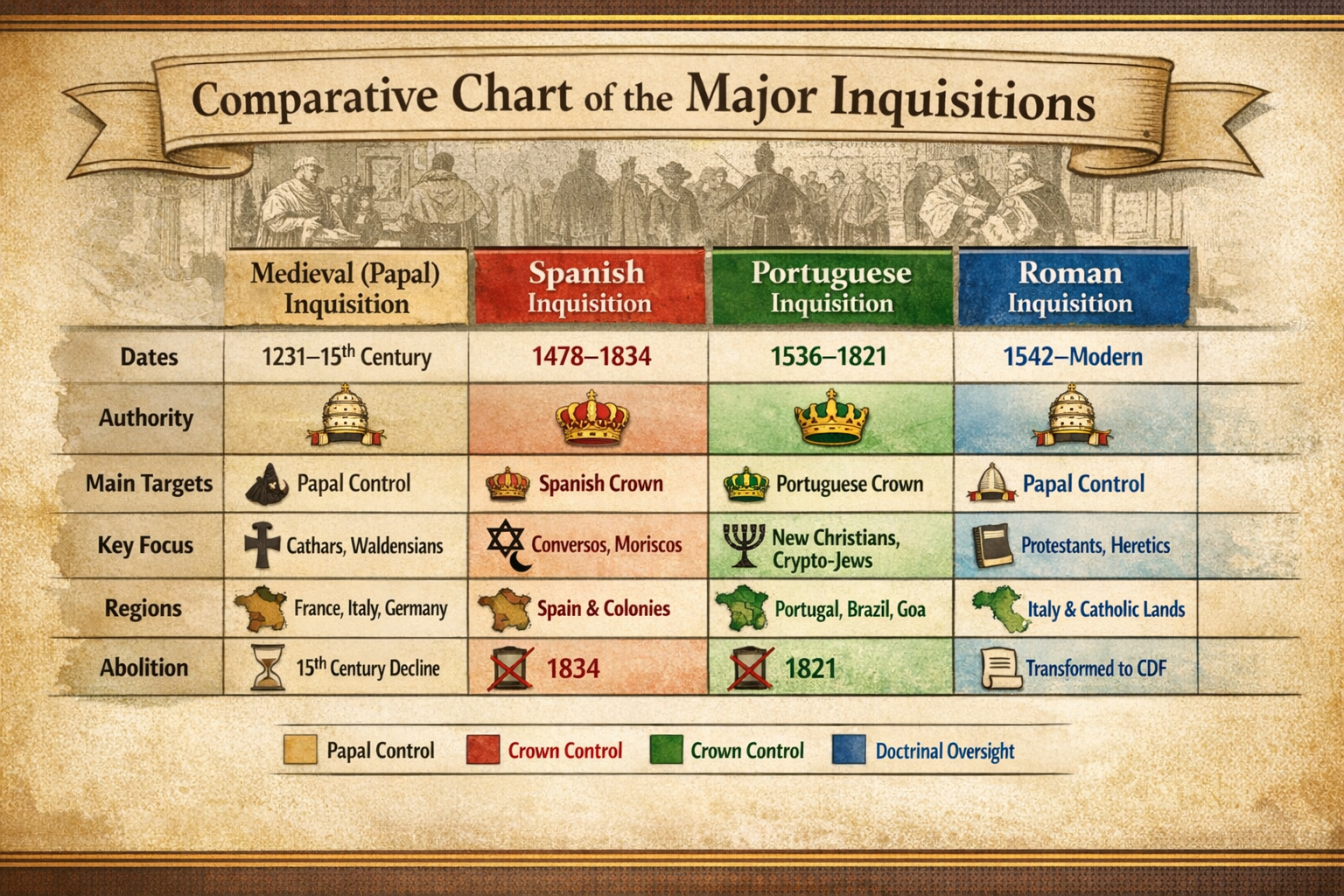
During the twelfth and early thirteenth centuries, Western Europe experienced the growth of organised religious dissent, particularly from movements such as the Albigensians (Cathars) in southern France and the Waldensians in northern Italy and France.
-
These groups rejected central Catholic doctrines, including sacramental theology, clerical authority, and papal supremacy, which Rome regarded as serious threats to ecclesiastical unity and social stability.
-
Prior to 1227, the responsibility for investigating heresy rested primarily with local bishops, but their efforts were often inconsistent, localised, and perceived by the papacy as ineffective in areas where dissent had become widespread.
-
Pope Innocent III escalated the Church’s response by initiating the Albigensian Crusade in 1209, combining military force with theological enforcement.
-
The Fourth Lateran Council of 1215 formally required secular rulers to punish heretics and confiscate their property, reinforcing the alliance between ecclesiastical and civil authority.
-
In 1227, under Pope Gregory IX, the papacy consolidated a permanent tribunal known as the Holy Office, marking the formal institutionalisation of what historians call the Papal Inquisition.
-
This new institution operated independently of local episcopal authority and functioned directly under papal control, allowing Rome to centralise the detection and prosecution of heresy across Catholic Europe.
-
The establishment of the Holy Office transformed anti-heresy efforts from occasional pastoral correction into a systematic and legally structured judicial process dedicated exclusively to suppressing religious dissent.
-
The Inquisition was primarily staffed by members of the Dominican Order, whose theological education and training in scholastic disputation made them particularly suited to interrogate suspected heretics and identify doctrinal deviations.
-
The inquisitorial procedure replaced earlier accusatorial systems by allowing the inquisitor to act simultaneously as investigator, prosecutor, and judge in secret proceedings.
-
Under this system, suspicion alone was sufficient to initiate formal inquiry, and the accused were not informed of the identities of witnesses or accusers.
-
In 1252, Pope Innocent IV issued the papal bull Ad extirpanda, which formally authorised the limited use of torture, including the rack, to obtain confessions and information about other suspected heretics.
-
Although canon law forbade clerics from shedding blood, those who refused to confess or who relapsed after repentance were handed over to secular authorities for execution, typically by burning at the stake.
-
When inquisitors entered a town, they typically announced a “period of grace”, during which individuals were invited to confess voluntarily and reconcile with the Church in exchange for lighter penalties.
-
Those who confessed during this grace period were usually assigned acts of penance such as pilgrimages, fines, public humiliation, or the wearing of distinctive crosses sewn onto their clothing to mark their former heresy.
-
After the grace period expired, the inquisitor initiated the “special inquisition”, which focused on identifying and prosecuting those who had not come forward voluntarily.
-
Trials were conducted in secrecy, and the accused were denied knowledge of their accusers in order to protect informants and encourage denunciations.
-
Confession was considered the strongest form of proof, and the use of torture after 1252 was justified as a method to secure repentance and reveal additional suspects.
-
Property confiscation became a central punitive measure, as those convicted of heresy often suffered what was termed “civil death”, losing the right to hold office, execute wills, or inherit property.
-
The confiscation of goods not only punished the individual but also frequently left families impoverished and socially marginalised.
-
Secular rulers cooperated with the Inquisition because confiscated property provided financial incentives and strengthened alliances between church and state authorities.
-
Movements such as the Albigensians responded by retreating into secrecy, developing underground networks, and strengthening communal bonds, but sustained pressure from both crusade and inquisition eventually dismantled their organised presence.
-
The Waldensians adapted differently by spreading into remote alpine regions and surviving through clandestine preaching, eventually aligning with elements of the Protestant Reformation in the sixteenth century.
-
Over time, the Inquisition became one of the most feared institutions of the Middle Ages because accusation alone could initiate investigation, and acquittal was extremely difficult once formal proceedings began.
-
The Holy Office functioned not merely as a religious tribunal but as an instrument of institutional control that fused theological enforcement with political authority in mediaeval Christendom.
References
-
Edward Peters, Inquisition (New York: Free Press, 1988).
-
Henry Charles Lea, A History of the Inquisition of the Middle Ages, Vol. 1 (New York: Harper & Brothers, 1888).
-
Malcolm Lambert, Mediaeval Heresy: Popular Movements from the Gregorian Reform to the Reformation (Oxford: Blackwell, 2002).
-
R. I. Moore, The Formation of a Persecuting Society (Oxford: Blackwell, 1987).
-
Bernard Hamilton, The Mediaeval Inquisition (London: Holmes & Meier, 1981).
Add comment
Comments