

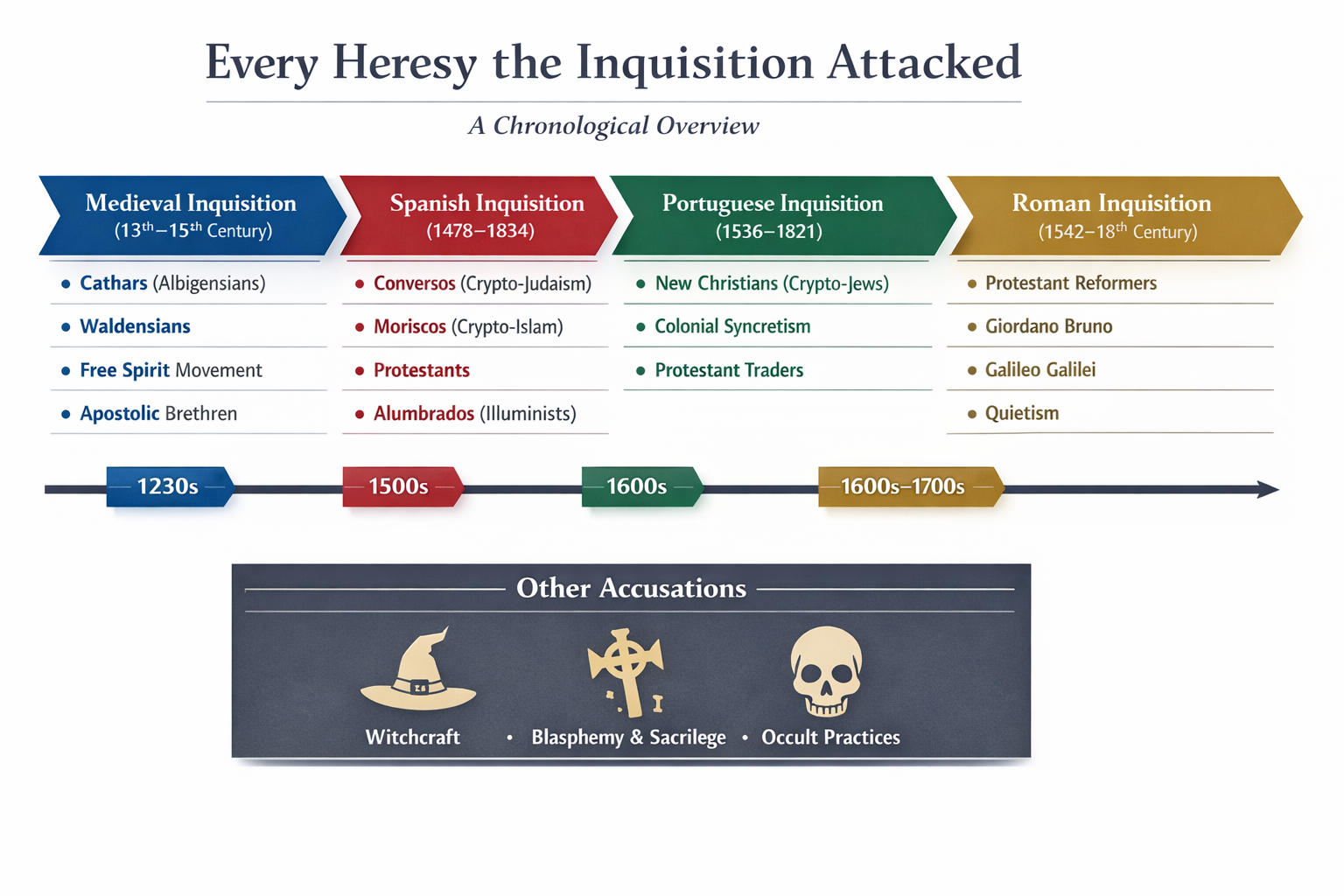
Every Major Heresy Targeted by the Inquisition
The Medieval (Papal) Inquisition (13th–15th Century)
- The Inquisition focused mainly on removing organised theological dissent inside Catholic Europe, especially in regions where alternative Christian movements threatened Church unity.
- It was different from earlier episcopal inquisitions because it became a centralised papal institution, officially formalised around 1227–1231 under Pope Gregory IX.
- It was designed to systematically eliminate remaining threats after military crusades failed to stop the spread of heresy.
The Catharism
- Catharism, also called the Albigensian movement, was a neo-Gnostic dualist movement in southern France (Languedoc) and northern Italy.
- Cathars taught that the material world was created by an evil lesser god called the Demiurge or Satan, while the spiritual world belonged to a good God.
- They rejected the physical body and the material world as corrupt.
- They divided followers into two classes: the “perfects” (ascetic elite who rejected meat, sex, and oaths) and the “believers” (ordinary followers who received the consolamentum spiritual baptism at death).
- They rejected Catholic sacraments such as the Eucharist and baptism by water.
- They denied the Incarnation and Resurrection of Christ, believing Christ did not have a physical body.
- They called the Catholic Church the “Whore of Babylon”.
- The Church launched the Albigensian Crusade (1209–1229), including events like the massacre at Béziers (1209) and the burning at Montségur (1244).
- Because surviving believers went underground, the Inquisition was created to finish what the armies could not.
- Inquisitors hunted hidden “perfects” in villages using torture and informants to expose secret rites in forests and cellars.
The Waldensians
- The Waldensians, also called the Poor of Lyon, were founded by Peter Waldo around 1205.
- Waldo gave away his wealth and preached apostolic poverty.
- Unlike the Cathars, they were not dualists but wanted a return to the early Church’s simplicity.
- They encouraged lay preaching and Bible reading in the common language instead of Latin.
- They rejected oaths, indulgences, purgatory, and clerical wealth.
- They criticised priests who lived immoral lives.
- The movement spread among peasants and artisans in France, Italy, and the Alps.
- They were condemned at the Council of Verona in 1184.
- Inquisitors targeted their travelling preachers and secret Bible groups.
- They survived underground for centuries and later joined the Protestant Reformation in the 16th century.
The Free Spirit Movement
- The Free Spirit Movement was a loose network of mystics and beguines in Northern Europe.
- They believed that once a soul was united with God, it could not sin.
- They taught that spiritually perfect people were no longer under church authority or moral law.
- Marguerite Porete was burnt in 1310 for her book The Mirror of Simple Souls.
- The movement was condemned at the Council of Vienne (1311–1312).
- Inquisitors often targeted beguine communities.
The Fraticelli
- The Fraticelli were a strict group within the Franciscan Order.
- They believed Jesus and the apostles owned absolutely nothing.
- They accused the Church of corruption and wealth.
- When Pope John XXII declared absolute poverty heretical in 1323, they declared the Pope a heretic.
- The Inquisition pursued them in Italy and southern France.
- Many were burnt for rejecting papal authority.
The Dolcinians
- The Dolcinians were led by Fra Dolcino in Northern Italy.
- They preached the end of the world and the destruction of the Church hierarchy.
- They fought in armed resistance in the Alps.
- Fra Dolcino was captured and executed in 1307.
- The movement was destroyed.
The Knights Templar
- The Knights Templar were accused of heresy between 1307 and 1312.
- They were charged with idolatry, denying Christ, and worshipping a head called “Baphomet”.
- Torture was used to extract confessions.
- The Order was suppressed in 1312.
- Jacques de Molay was burnt in 1314.
The Lollards
- The Lollards followed John Wycliffe in 14th-century England.
- They rejected transubstantiation.
- They promoted the English Bible.
- They claimed the Bible was the only authority, not the Pope.
- The law De Heretico Comburendo (1401) allowed the burning of heretics.
- They influenced the English Reformation.
The Hussites
- The Hussites followed Jan Hus in Bohemia.
- Hus was tried and burnt at the Council of Constance in 1415.
- His death caused the Hussite Wars.
- The Inquisition struggled to control Bohemia due to military resistance.
The Spanish Inquisition (1478–1834)
- It was established by Ferdinand and Isabella with papal approval but was controlled by the state.
- It aimed at political and religious unity in Spain.
- The primary target was conversos, Jews who had converted but were suspected of secretly practising Judaism.
- In 1492, Jews were expelled from Spain.
- The concept of limpieza de sangre (purity of blood) restricted those with Jewish or Muslim ancestry.
- Moriscos were Muslims forced to convert after 1492.
- Islamic customs were banned.
- Moriscos were expelled in 1609.
- The Inquisition targeted Protestants and mystics called Alumbrados.
- Public executions called autos-da-fé eliminated Protestant groups in 1559.
The Portuguese Inquisition (1536–1821)
- It followed the Spanish model.
- It targeted converted Sephardic Jews.
- It expanded to colonies, especially Goa in India.
- It targeted local Hindus and Christians who resisted Latin rites.
The Roman Inquisition (1542–1860)
- It was established by Pope Paul III.
- It aimed to stop Protestantism in Italy.
- It targeted reform-minded Catholics called “Spirituali”.
- It renewed persecution of Waldensians.
- Giordano Bruno was burnt in 1600 for denying the Trinity and Incarnation.
- Galileo was tried in 1633 for supporting heliocentrism.
- Jews in Rome were confined to ghettos and forced to attend sermons.
Summary of Historical Development
- The Mediaeval Inquisition targeted sectarian heretics inside Christian society.
- The Spanish and Portuguese Inquisitions targeted converted Jews and Muslims for national unity.
- The Roman Inquisition targeted Protestants and intellectuals to defend Catholic doctrine.
References
- Edward Peters, Inquisition (New York: Free Press, 1988).
- Malcolm Lambert, Mediaeval Heresy (Oxford: Blackwell, 2002).
Add comment
Comments