

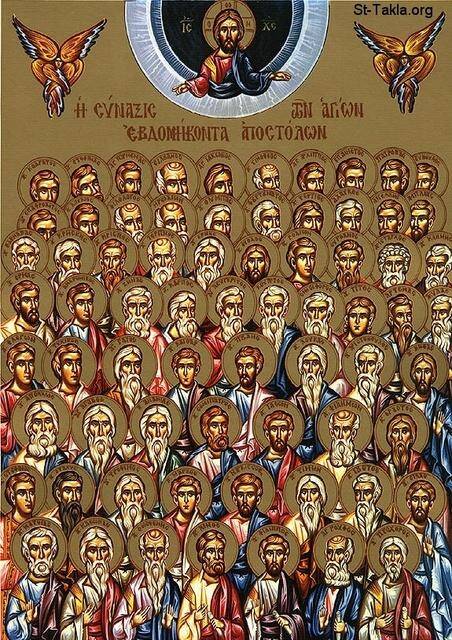
The Seventy (Seventy-Two) Disciples of Jesus Christ
The Seventy (Seventy-Two) Disciples of Jesus Christ
An article from a Coptic Orthodox / Orthodox Christian point of view
A note on Bible quotations: Full verses in this article are quoted from the World English Bible (WEB), which is in the public domain. Every quotation is clearly marked with its book, chapter, and verse so that the NIV text can be inserted at each reference if desired. The meaning of the passages is the same across faithful translations.
Introduction: Who Were the Seventy Disciples?
- The Seventy (or Seventy-Two) Disciples were a group of followers whom the Lord Jesus Christ Himself chose and sent out to preach.
- They are sometimes called the “Seventy Apostles” in Orthodox tradition, because the word “apostle” means “one who is sent".
- They were sent in addition to the Twelve Apostles, not instead of them.
- Their mission shows that the Gospel was never meant for a small circle only. It was meant for every city and every nation.
- The Church honours them as the first wave of evangelists — ordinary men who carried the extraordinary message of the Kingdom of God.
- The Eastern Orthodox Church keeps a common feast for the Seventy Apostles on 4 January, and the Coptic Orthodox Church remembers many of them individually in the Synaxarium (the daily book of the saints).
1. Bible Passages About the Seventy / Seventy-Two
The main passage: Luke 10:1–24
This passage is the only place in the Bible where the group is directly described. Here are the key verses (WEB):
Luke 10:1–3 > “Now after these things, the Lord also appointed seventy others and sent them two by two ahead of him into every city and place where he was about to come. Then he said to them, ‘The harvest is indeed plentiful, but the labourers are few. Pray, therefore, to the Lord of the harvest that he may send out labourers into his harvest. Go your ways. Behold, I send you out as lambs among wolves.’”
Luke 10:4–9 > “‘Carry no purse, nor wallet, nor sandals. Greet no one on the way. Into whatever house you enter, first say, “Peace be to this house.” If a son of peace is there, your peace will rest on him; but if not, it will return to you. Remain in that same house, eating and drinking the things they give, for the labourer is worthy of his wages. Don’t go from house to house. Into whatever city you enter and they receive you, eat the things that are set before you. Heal the sick who are there and tell them, “God’s Kingdom has come near to you.”’”
Luke 10:16 > “‘Whoever listens to you listens to me, and whoever rejects you rejects me. Whoever rejects me rejects him who sent me.’”
Luke 10:17–20 > “The seventy returned with joy, saying, ‘Lord, even the demons are subject to us in your name!’ He said to them, ‘I saw Satan having fallen like lightning from heaven. Behold, I give you authority to tread on serpents and scorpions and over all the power of the enemy. Nothing will in any way hurt you. Nevertheless, don’t rejoice in this, that the spirits are subject to you, but rejoice that your names are written in heaven.’”
Luke 10:21, 23–24 > “In that same hour, Jesus rejoiced in the Holy Spirit and said, ‘I thank you, O Father, Lord of heaven and earth, that you have hidden these things from the wise and understanding and revealed them to little children. Yes, Father, for so it was well-pleasing in your sight.' Turning to the disciples, he said privately, ‘Blessed are the eyes which see the things that you see, for I tell you that many prophets and kings desired to see the things which you see, and didn’t see them; and to hear the things which you hear, and didn’t hear them.'
From this passage we learn the following:
- Jesus Himself appointed them. They did not appoint themselves.
- He sent them two by two — the mission is done in fellowship, not alone.
- They preached the Kingdom of God — “God’s Kingdom has come near to you.”
- They healed the sick — the Gospel brings healing to body and soul.
- They returned with joy — even the demons submitted in the name of Jesus.
- Jesus saw Satan fall like lightning — their humble mission was a real victory over the power of evil.
- The greatest joy is salvation — "Rejoice that your names are written in heaven.”
Why do some Bibles say “seventy” and some say “seventy-two”?
- The New Testament was copied by hand for many centuries. In Luke 10:1 and Luke 10:17, some ancient manuscripts read “seventy” and others read "seventy-two".
- Very old and respected manuscripts exist on both sides, so translators make different choices:
- Translations such as the KJV, NKJV, and WEB say seventy.
- Translations such as the NIV and ESV say seventy-two (often with a footnote mentioning “seventy”).
- This is not a contradiction. It is a small copying difference in one number, and both readings carry the same meaning: Christ appointed a large group of disciples for mission, far beyond the Twelve.
- Many Church Fathers saw a beautiful symbolism in both numbers:
- Seventy recalls the seventy elders of Moses (Numbers 11) and the traditional count of seventy nations in Genesis 10 (Hebrew text).
- Seventy-two matches the count of the nations in the ancient Greek translation (the Septuagint) and equals 6 × 12 — the mission of the Twelve multiplied outward.
- Either way, the message is the same: the Gospel is going out to all the nations of the earth.
- The Orthodox Church traditionally uses the number seventy, following the reading received in the church.
Supporting passages
Numbers 11:16–17 (WEB) — Moses and the seventy elders, a foreshadowing of the Seventy: > “The LORD said to Moses, ‘Gather to me seventy men of the elders of Israel, whom you know to be the elders of the people and officers over them; and bring them to the Tent of Meeting, that they may stand there with you. I will come down and talk with you there. I will take of the Spirit which is on you, and will put it on them; and they shall bear the burden of the people with you, that you don’t bear it yourself alone.’”
- Just as God gave His Spirit to seventy elders to help Moses shepherd Israel, so Christ appointed seventy to share in the work of the Gospel.
Genesis 10 — the “Table of Nations": Genesis 10 lists the descendants of Noah’s sons, from whom the nations of the earth spread out. - The Hebrew text has traditionally been counted as seventy nations; the Greek Septuagint counts seventy-two. - Church tradition connects the Seventy(-Two) Disciples with these nations: one messenger, as it were, for every nation of the world.
Matthew 28:18–20 (WEB) — the Great Commission: > “Jesus came to them and spoke to them, saying, ‘All authority has been given to me in heaven and on earth. Go and make disciples of all nations, baptising them in the name of the Father and of the Son and of the Holy Spirit, teaching them to observe all things that I commanded you. Behold, I am with you always, even to the end of the age.’”
Acts 1:8 (WEB) — witness to the ends of the earth: > “But you will receive power when the Holy Spirit comes upon you. You will be witnesses to me in Jerusalem, in all Judea and Samaria, and to the uttermost parts of the earth.”
- The mission of the Seventy in Luke 10 was a first rehearsal of this worldwide mission, which they later fulfilled after Pentecost.
2. The Twelve Apostles and the Seventy Disciples: What Is the Difference?
Both groups were chosen and sent by Christ, but their roles were not identical.
The Twelve Apostles
- Luke 6:12–13 (WEB): “In these days, he went out to the mountain to pray, and he continued all night in prayer to God. When it was day, he called his disciples, and from them he chose twelve, whom he also named apostles.”
- Matthew 10:1–4 lists their names: Peter, Andrew, James, John, Philip, Bartholomew, Thomas, Matthew, James son of Alphaeus, Thaddaeus, Simon the Zealot, and Judas Iscariot (later replaced by Matthias).
- The Twelve had a special foundational role:
- They were constant eyewitnesses of Christ’s ministry, death, and resurrection.
- Their number matches the twelve tribes of Israel — they represent the new Israel, the Church.
- Ephesians 2:20 (WEB): the household of God is “built on the foundation of the apostles and prophets, Christ Jesus himself being the chief cornerstone.”
The Seventy Disciples
- The Seventy were also chosen and sent by Christ (Luke 10:1) — this was a great honour.
- Their number points outward to all the nations (Genesis 10), just as the Twelve point inward to the new Israel.
- They prepared the way before Christ “into every city and place where he was about to come” (Luke 10:1).
- After Pentecost, Church tradition says many of them became bishops, evangelists, and martyrs across the world.
In summary
- The Twelve: foundation stones of the Church; the new Israel.
- The Seventy: the wider circle of mission – the Gospel reaching every nation.
- Both were sent by the same Lord, preached the same Kingdom, and served the same Gospel.
- The Church needs both realities: a firm apostolic foundation and a wide missionary heart.
3. Church Tradition About the Names of the Seventy
First, an honest and important point
- The New Testament does not give a complete list of the Seventy. Luke 10 tells us they existed and what they did, but it does not name them.
- The traditional lists come from Church tradition, written down centuries later.
- The two most famous ancient lists are attributed to Dorotheus of Tyre and to Hippolytus of Rome, but scholars agree these lists were actually compiled later by unknown authors. For this reason they are called “Pseudo-Dorotheus” and "Pseudo-Hippolytus".
- Because these lists were assembled from memory, from local traditions, and from names found in the New Testament letters, the ancient lists do not agree exactly with each other. Some names appear in one list and not another; some names are spelt differently; occasionally a name seems to be repeated.
- The Orthodox Church receives these lists with love and honour but does not treat them as Scripture. It is right to say, "The Bible says the Seventy existed; church tradition suggests who they were.”
How the lists were built
- Compilers gathered the names of Christ’s co-workers found in Acts and in the epistles of St Paul (especially Romans 16, Colossians 4, and 2 Timothy 4).
- The reasoning was simple and reverent: those whom the apostles trusted as fellow labourers were very likely among the wider circle of disciples whom Christ Himself had sent.
- Some of this reasoning is sound; some of it is uncertain. That is why careful language is needed.
The list connected with Pseudo-Dorotheus (attributed to Dorotheus of Tyre, c. 4th century; compiled later)
Church tradition connected with this list includes names such as the following:
- James the Lord’s brother, Mark the Evangelist, Luke the Evangelist, Cleopas, Symeon (Simeon) of Jerusalem, Barnabas, Justus (Joseph Barsabbas), Thaddaeus, Ananias of Damascus
- Stephen, Philip the Evangelist, Prochorus, Nicanor, Timon, Parmenas (of the seven deacons)
- Timothy, Titus, Philemon, Onesimus, Epaphras, Archippus, Silas, Silvanus, Crescens
- Crispus, Epaenetus, Andronicus, Stachys, Amplias, Urbanus, Narcissus, Apelles, Aristobulus, Herodion
- Agabus, Rufus, Asyncritus, Phlegon, Hermes, Patrobas, Hermas, Linus, Gaius, Philologus
- Lucius, Jason, Sosipater, Olympas, Tertius, Erastus, Quartus, Apollos, Sosthenes, Tychicus
- Epaphroditus, Carpus, Quadratus, Mark (John Mark), Zenas, Aristarchus, Pudens, Trophimus, Artemas, Aquila
- Fortunatus, Achaicus, and others
Note: This list is from Church tradition and is not certain in every detail. Some manuscripts of the list differ from each other.
The list connected with Pseudo-Hippolytus (“On the Seventy Apostles”)
- This list is very similar to the Pseudo-Dorotheus list and contains largely the same names.
- It often adds, for each name, the city where the disciple served as bishop (for example, "Linus, bishop of Rome; Prochorus, bishop of Nicomedia; Titus, bishop of Crete”).
- Because it was compiled later and attributed to St Hippolytus, its details are honoured as tradition, not as certain history.
The Eastern Orthodox tradition
- The Eastern Orthodox Church keeps the Synaxis (common feast) of the Seventy Apostles on 4 January.
- The Orthodox list used today is essentially the ancient list above, received and polished through the centuries.
- Interesting honest details in the Orthodox tradition itself:
- The Church remembers that two of the original Seventy fell away (tradition names Nicolas of Antioch, connected by some Fathers with the sect of the Nicolaitans, and Cephas – not Peter – mentioned by some ancient writers). Tradition says their places were filled by others.
- This shows the Church has always known the list is a living tradition, not a fixed Bible text.
The Coptic Orthodox tradition
- The Coptic Orthodox Church honours the Seventy (in Arabic, al-Sabʿūn Rasūlan, “the Seventy Apostles”) and remembers many of them individually in the Coptic Synaxarium on their own feast days.
- The Coptic Church does not depend on one single official list of all seventy; rather, it receives the same broad tradition of names known in the universal Orthodox Church.
- Above all, the Coptic Church treasures St Mark the Evangelist, counted among the Seventy by tradition, who brought the Gospel to Egypt and founded the Church of Alexandria.
- The Coptic Synaxarium also commemorates many others traditionally counted among the Seventy, such as Barnabas, Matthias (before his election to the Twelve), Ananias, Stephen, Philip, Timothy, Titus, Silas, Apollos, and the companions of St Paul.
Careful summary: All these lists agree on the great majority of names, because they all draw from the New Testament itself. Where they differ, the Church simply says, "This detail is uncertain.” The certainty is not in the list — the certainty is in Christ who sent them.
4–5. People in the Bible Who Are Counted Among the Seventy (with Bible References)
Below are the people from the New Testament whom Orthodox tradition places among the Seventy. For each one you will find the Bible references, a key verse (WEB) where helpful, a short biography, and a clear note on what is Scripture and what is tradition.
General note: The Bible itself never says “this person was one of the Seventy” about anyone by name. In every case below, membership in the Seventy is from Church tradition. What the Bible clearly gives us is each person’s life and service.
Barnabas
- Bible references: Acts 4:36–37; Acts 9:27; Acts 11:22–26; Acts 13:1–3; Acts 15:36–39; 1 Corinthians 9:6; Galatians 2:1, 9, 13; Colossians 4:10.
- Key verse — Acts 4:36–37 (WEB): “Joses, who by the apostles was also called Barnabas (which is, being interpreted, Son of Encouragement), a Levite, a man of Cyprus by race, having a field, sold it and brought the money and laid it at the apostles’ feet.”
- Key verse — Acts 11:24 (WEB): “For he was a good man, and full of the Holy Spirit and of faith, and many people were added to the Lord.”
- Who he was: A Levite from Cyprus, generous and encouraging. He introduced St Paul to the apostles, brought him to Antioch, and travelled with him on the first missionary journey.
- Tradition says he was one of the Seventy, preached in Cyprus, and was martyred there. He is honoured as the founder of the Church of Cyprus.
- The Bible clearly shows his apostolic work; his place among the Seventy is from tradition and is widely received in the Orthodox Church.
Matthias
- Bible references: Acts 1:21–26.
- Key verse — Acts 1:24, 26 (WEB): “They prayed and said, ‘You, Lord, who know the hearts of all men, show which one of these two you have chosen’… They drew lots for them, and the lot fell on Matthias, and he was counted with the eleven apostles.”
- Who he was: A disciple who had followed Jesus “beginning from the baptism of John” (Acts 1:22). After the fall of Judas, he was chosen by lot to join the Twelve.
- Tradition says: Before his election he was one of the Seventy — this fits well with Acts 1:21–22, which requires that he had been with Jesus from the beginning. Tradition says he preached in Judea and beyond and died a martyr.
- His election to the Twelve is Scripture; his earlier place among the Seventy is tradition, and it is one of the most reasonable traditions.
Justus (Joseph Barsabbas)
- Bible references: Acts 1:23.
- Key verse — Acts 1:23 (WEB): “They put forward two: Joseph called Barsabbas, who was also called Justus, and Matthias.”
- Who he was: The other candidate proposed with Matthias; therefore, he was also a long-standing disciple of Jesus.
- Tradition says he was one of the Seventy and later served as a bishop (tradition names Eleutheropolis in Palestine). Some traditions say he suffered for Christ. These details are from tradition and are not certain.
Mark the Evangelist
- Bible references: Acts 12:12, 25; Acts 13:5, 13; Acts 15:36–39; Colossians 4:10; 2 Timothy 4:11; Philemon 1:24; 1 Peter 5:13.
- Key verse — 2 Timothy 4:11 (WEB): “Only Luke is with me. Take Mark and bring him with you, for he is useful to me for service.”
- Key verse — 1 Peter 5:13 (WEB): “She who is in Babylon, chosen together with you, greets you. So does Mark, my son.”
- Who he was: John Mark of Jerusalem, whose mother’s house was a meeting place of the first Church (Acts 12:12). Companion of Barnabas, Paul, and Peter; writer of the Gospel of Mark.
- Coptic tradition says St Mark was one of the Seventy; that his family’s house hosted the Lord’s Supper and Pentecost; that he preached in Egypt, founded the Church of Alexandria, ordained its first clergy, and was martyred in Alexandria (traditionally in 68 AD), dragged through the streets of the city.
- His Gospel and his service with the apostles are Scripture; his membership in the Seventy and his Egyptian mission are treasured Church tradition, held with great honour in the Coptic Orthodox Church.
Luke the Evangelist
- Bible references: Colossians 4:14; 2 Timothy 4:11; Philemon 1:24 (also the “we” passages of Acts, e.g., Acts 16:10).
- Key verse — Colossians 4:14 (WEB): “Luke the beloved physician and Demas greet you.”
- Who he was: A physician, companion of St Paul, and writer of the Gospel of Luke and the Acts of the Apostles. He is the very evangelist who recorded the sending of the Seventy.
- Tradition says: He was one of the Seventy and one of the two disciples on the road to Emmaus (Luke 24 names only Cleopas; tradition supplies Luke as the unnamed companion — this is tradition and is not certain). Tradition says he preached in Greece and elsewhere, painted the first icon of the Virgin Mary, and died in old age (some traditions say as a martyr).
Cleopas
- Bible references: Luke 24:13–35.
- Key verse — Luke 24:18 (WEB): “One of them, named Cleopas, answered him, ‘Are you the only stranger in Jerusalem who doesn’t know the things which have happened there in these days?’”
- Who he was: One of the two disciples to whom the risen Christ appeared on the road to Emmaus, and whose hearts "burnt within” them as He opened the scriptures.
- Tradition says he was one of the Seventy, a relative of St Joseph, and later suffered for his witness to the risen Christ. These details are from tradition.
Ananias of Damascus
- Bible references: Acts 9:10–19; Acts 22:12–16.
- Key verse — Acts 9:17 (WEB): “Ananias departed and entered into the house. Laying his hands on him, he said, ‘Brother Saul, the Lord, who appeared to you on the road by which you came, has sent me that you may receive your sight and be filled with the Holy Spirit.’”
- Who he was: “A devout man according to the law” (Acts 22:12) who baptised Saul of Tarsus at the Lord’s command.
- Tradition says: He was one of the Seventy, became bishop of Damascus, and was martyred. These details are from tradition.
Stephen the Protomartyr
- Bible references: Acts 6:1–8:2; Acts 11:19; Acts 22:20.
- Key verse — Acts 7:59–60 (WEB): “They stoned Stephen as he called out, saying, ‘Lord Jesus, receive my spirit!’ He knelt down and cried with a loud voice, ‘Lord, don’t hold this sin against them.’ When he had said this, he fell asleep.”
- Who he was: One of the seven deacons, “full of faith and of the Holy Spirit” (Acts 6:5), and the first martyr of the Church.
- Tradition says he was among the Seventy. His deaconship and martyrdom are Scripture; his place in the Seventy is tradition.
Philip the Evangelist
- Bible references: Acts 6:5; Acts 8:5–40; Acts 21:8–9.
- Key verse — Acts 8:5 (WEB): “Philip went down to the city of Samaria and proclaimed to them the Christ.”
- Who he was: One of the seven deacons; he evangelised Samaria and baptised the Ethiopian eunuch — through whom, tradition says, the Gospel first reached Africa. He is distinct from Philip of the Twelve.
- Tradition says he was one of the Seventy and later served as a bishop (tradition names Tralles in Asia Minor). This is tradition and is not certain.
Prochorus, Nicanor, Timon, Parmenas, and Nicolas (the rest of the seven deacons)
- Bible references: Acts 6:5.
- Key verse — Acts 6:5 (WEB): “These words pleased the whole multitude. They chose Stephen, a man full of faith and of the Holy Spirit, Philip, Prochorus, Nicanor, Timon, Parmenas, and Nicolas, a proselyte of Antioch.”
- Prochorus: Tradition says he was a companion of St John the Theologian, became bishop of Nicomedia, and died a martyr. Tradition also connects him with writing down the Gospel of John as John’s scribe — this detail is uncertain.
- Nicanor: Tradition says he was martyred on the same day as St Stephen, or soon after. Uncertain in detail.
- Timon: Tradition says he became a bishop (Bostra in Arabia is named) and died a martyr. Uncertain in detail.
- Parmenas: Tradition says he served faithfully and died either in peace or as a martyr; accounts differ. Uncertain.
- Nicolas of Antioch: The Bible names him as one of the seven. Some Church Fathers connected him with the later sect of the “Nicolaitans” (Revelation 2:6, 15); others defended him. Because of this, many traditional lists of the Seventy either exclude him or say he fell away. This is a clear example of why the ancient lists differ, and it must be said honestly: the matter is uncertain.
Silas / Silvanus
- Bible references: Acts 15:22, 32, 40; Acts 16:19–34; Acts 17:4, 10; 1 Thessalonians 1:1; 2 Thessalonians 1:1; 2 Corinthians 1:19; 1 Peter 5:12.
- Key verse — Acts 15:32 (WEB): “Judas and Silas, also being prophets themselves, encouraged the brothers with many words and strengthened them.”
- Who he was: A leading man among the brethren in Jerusalem, a prophet, a companion of St Paul on the second journey, a fellow prisoner in Philippi, and a later helper of St Peter.
- Tradition says: He was one of the Seventy and became bishop of Corinth. Some traditions treat “Silas” and “Silvanus” as two persons and list both; most understand them as one man with a Greek and a Latin form of the same name. This difference is another honest example of why the lists vary.
Timothy
- Bible references: Acts 16:1–3; Romans 16:21; 1 Corinthians 4:17; Philippians 2:19–22; 1 Timothy 1:2; 2 Timothy 1:2–5; Hebrews 13:23.
- Key verse — 1 Timothy 1:2 (WEB): “…to Timothy, my true child in faith: grace, mercy, and peace from God our Father and Christ Jesus our Lord.”
- Who he was: son of a believing Jewish mother (Eunice) and a Greek father; St Paul’s beloved spiritual son and co-worker; recipient of two epistles.
- Tradition says he is counted with the Seventy in the broad sense of the apostolic circle and became the first bishop of Ephesus, where tradition says he was martyred. Note honestly: Timothy became a disciple during Paul’s journeys, so his inclusion among the original seventy of Luke 10 is symbolic — the Church lists him among the “Seventy Apostles” as an honour of equal apostolic labour. This is tradition, not Scripture.
Titus
- Bible references: 2 Corinthians 2:13; 7:6–7, 13–15; 8:16–23; Galatians 2:1–3; 2 Timothy 4:10; Titus 1:4–5.
- Key verse — Titus 1:4–5 (WEB): “…to Titus, my true child according to a common faith: grace, mercy, and peace from God the Father and the Lord Jesus Christ our Saviour. I left you in Crete for this reason, that you would set in order the things that were lacking and appoint elders in every city, as I directed you.”
- Who he was: A Greek convert, trusted delegate of St Paul, and organiser of the church in Crete.
- Tradition says he is counted among the Seventy Apostles and was the first bishop of Crete, dying there in peace at a great age. The same honest note as Timothy applies.
Philemon, Onesimus, and Archippus
- Bible references: the Epistle to Philemon; Colossians 4:9, 17.
- Key verse — Philemon 1:10–11 (WEB): “I appeal to you for my child Onesimus, whom I have become the father of in my chains, who once was useless to you but now is useful to you and to me.”
- Philemon: A Christian of Colossae whose house hosted a church. Tradition says he became a bishop (Gaza is named) and was martyred with his wife Apphia. Tradition, not certain.
- Onesimus: The runaway slave who became “a beloved brother” (Philemon 1:16). Tradition says he later served the Church as a bishop and was martyred. Tradition, not certain.
- Archippus: Told to “fulfil the ministry” he received (Colossians 4:17). Tradition counts him among the Seventy and says he was martyred with Philemon. Tradition, not certain.
Apollos
- Bible references: Acts 18:24–28; 1 Corinthians 1:12; 3:4–6; 16:12; Titus 3:13.
- Key verse — Acts 18:24–25 (WEB): “Now a certain Jew named Apollos, an Alexandrian by race, an eloquent man, came to Ephesus. He was mighty in the Scriptures. This man had been instructed in the way of the Lord; and being fervent in spirit, he spoke and taught accurately the things concerning Jesus.”
- Who he was: An eloquent Alexandrian teacher who “watered” what Paul planted (1 Corinthians 3:6).
- Tradition says he is counted among the Seventy Apostles and served as a bishop (traditions name Caesarea or Corinth). Since he appears in Acts as a later convert, his listing among the Seventy is honorary tradition, and this should be said plainly.
Sosthenes
- Bible references: Acts 18:17; 1 Corinthians 1:1.
- Key verse — 1 Corinthians 1:1 (WEB): “Paul, called to be an apostle of Jesus Christ through the will of God, and our brother Sosthenes…”
- Who he was: Likely the synagogue ruler of Corinth who later believed and joined St Paul.
- Tradition says he was one of the Seventy and became a bishop (Colophon is named). Tradition, not certain.
Tychicus and Trophimus
- Bible references: Acts 20:4; Acts 21:29; Ephesians 6:21–22; Colossians 4:7–8; 2 Timothy 4:12, 20; Titus 3:12.
- Key verse — Ephesians 6:21 (WEB): “But that you also may know my affairs, how I am doing, Tychicus, the beloved brother and faithful servant in the Lord, will make known to you all things.”
- Tychicus: Carrier of the epistles to Ephesus and Colossae. Tradition says he became a bishop (Colophon or Chalcedon is named). Tradition, not certain.
- Trophimus: An Ephesian companion of Paul, left ill at Miletus (2 Timothy 4:20). Tradition says he was martyred with St Paul in Rome. Tradition, not certain.
Epaphras and Epaphroditus
- Bible references: Colossians 1:7; 4:12–13; Philemon 1:23; Philippians 2:25–30; 4:18.
- Key verse — Colossians 4:12 (WEB): “Epaphras, who is one of you, a servant of Christ, salutes you, always striving for you in his prayers, that you may stand perfect and complete in all the will of God.”
- Epaphras: Founder-evangelist of the church in Colossae and Paul’s fellow prisoner. Tradition counts him among the Seventy and says he became bishop of Colossae. Tradition, not certain.
- Epaphroditus: The messenger of the Philippians who “for the work of Christ came near to death” (Philippians 2:30). Tradition says he became a bishop (Adriaca is named in some lists). Tradition, not certain. Some ancient lists treat Epaphras and Epaphroditus as one person, others as two – another honest example of why lists differ.
Clement
- Bible references: Philippians 4:3.
- Key verse — Philippians 4:3 (WEB): “…help these women, for they laboured with me in the Good News, with Clement also, and the rest of my fellow workers whose names are in the book of life.”
- Tradition says many identify this Clement with St Clement of Rome, an early bishop of Rome and writer of a famous epistle to the Corinthians, martyred in exile. The identification is ancient but not certain, and honest teaching should say so.
Linus
- Bible references: 2 Timothy 4:21.
- Key verse — 2 Timothy 4:21 (WEB): "...Eubulus salutes you, as do Pudens, Linus, Claudia, and all the brothers.”
- Tradition says Linus became the first bishop of Rome after the apostles Peter and Paul. He is counted among the Seventy. Tradition is widely received, but the details are from tradition.
Andronicus and Junia
- Bible references: Romans 16:7.
- Key verse — Romans 16:7 (WEB): “Greet Andronicus and Junia, my relatives and my fellow prisoners, who are notable among the apostles, who were also in Christ before me.”
- Andronicus: Because Paul says they were “in Christ before me” and “notable among the apostles", tradition confidently counts Andronicus among the Seventy and says he became a bishop (Pannonia is named).
- Junia: Honoured with Andronicus. The Orthodox Church commemorates Andronicus and Junia together (17 May in the Eastern calendar). Since the traditional number seventy refers to the men sent in Luke 10, Junia is honoured as an “equal to the apostles” companion of the seventy rather than formally one of the seventy in most lists. This nuance is from tradition.
The names of Romans 16 (Rufus, Urbanus, Stachys, Amplias, Apelles, Narcissus, Herodion, and others)
- Bible reference: Romans 16:8–13.
- Key verse — Romans 16:13 (WEB): “Greet Rufus, the chosen in the Lord, and his mother and mine.”
- Rufus: Possibly the son of Simon of Cyrene (Mark 15:21) — this connection is traditional and not certain. Tradition says he became a bishop (Thebes in Greece is named after him).
- Urbanus: “Our fellow worker in Christ” (Romans 16:9). Tradition: bishop in Macedonia; martyr. Not certain.
- Stachys: “My beloved” (Romans 16:9). Tradition: first bishop of Byzantium after St Andrew. Not certain.
- Amplias (Ampliatus): “My beloved in the Lord” (Romans 16:8). Tradition: bishop and martyr. Not certain.
- Apelles: “Approved in Christ” (Romans 16:10). Tradition: bishop (named Smyrna or Heraclea). Not certain.
- Narcissus: His household is greeted in Romans 16:11. Tradition: bishop of Athens; some lists say martyr. Not certain — and note that the verse greets “those of the household of Narcissus who are in the Lord", so even his own faith is inferred by tradition.
- Herodion: “My relative” (Romans 16:11). Tradition: bishop of New Patras; martyred. Not certain.
- These entries show clearly how the traditional lists were built out of Romans 16 and why we must speak with care.
Aristobulus
- Bible reference: Romans 16:10.
- Key verse — Romans 16:10 (WEB): "...Greet those who are of the household of Aristobulus.”
- Tradition says he was the brother of the apostle Barnabas and preached in Britain, where he served as a bishop and ended his life. This tradition is dear to many, but it must be said honestly: the Bible mentions only his household, and the British mission is from later tradition and is not certain.
Gaius, Jason, Sosipater, Lucius, Mnason, Agabus, Quadratus
- Gaius — Acts 19:29; 20:4; Romans 16:23; 1 Corinthians 1:14; 3 John 1:1. Paul’s host “and of the whole assembly” (Romans 16:23). Tradition: bishop of Ephesus after Timothy. Not certain (and there may be more than one Gaius in the New Testament).
- Jason — Acts 17:5–9; Romans 16:21. He sheltered Paul in Thessalonica at real personal risk. Tradition: bishop of Tarsus, later missionary to Corfu with Sosipater. Not certain.
- Sosipater (Sopater) — Acts 20:4; Romans 16:21. Paul’s relative and companion. Tradition: bishop of Iconium; missionary with Jason. Not certain.
- Lucius — Acts 13:1 (“Lucius of Cyrene”); Romans 16:21. A prophet-teacher of Antioch. Tradition: bishop of Laodicea in Syria. Not certain.
- Mnason — Acts 21:16. An "early disciple” of Cyprus who hosted Paul — the phrase “early disciple” is why tradition places him among the Seventy. Details of his later life are uncertain.
- Agabus — Acts 11:27–28; Acts 21:10–11. The prophet who foretold the famine and Paul’s arrest. Tradition counts him among the Seventy. Details uncertain.
- Quadratus — not named in the New Testament. He was an early apologist who, according to the historian Eusebius, was said to be a disciple of the apostles; some Orthodox lists include him among the Seventy. Because he is not in Scripture at all, this is clearly noted: this is from tradition and is not certain.
6. A Short Word on the Rest of the Traditional List
The remaining names in the traditional lists (such as Asyncritus, Phlegon, Hermes, Patrobas, Hermas, Philologus, Olympas, Tertius, Erastus, Quartus, Crescens, Crispus, Epaenetus, Carpus, Zenas, Artemas, Aristarchus, Pudens, Aquila, Fortunatus, Achaicus, Onesiphorus, Euodius, Symeon of Jerusalem, and Thaddaeus) follow the same pattern:
- The Bible gives us their names as co-workers and beloved brothers of the apostles (mostly in Romans 16, 1 Corinthians 16, Colossians 4, 2 Timothy 4, and Titus 3).
- Church tradition adds that each one became a bishop of a particular city, preached in a particular land, and died either in peace or as a martyr.
- The honest rule for all of them is the same: the names are Scripture; the episcopal cities and manner of death are tradition, and many details are uncertain.
A few worth highlighting:
- Symeon (Simeon) of Jerusalem — a relative of the Lord, second bishop of Jerusalem after James; tradition says he was martyred in extreme old age under Trajan. His bishopric is recorded by the early historians; his place among the Seventy is tradition.
- Thaddaeus (of the Seventy) — tradition distinguishes him from Thaddaeus/Jude of the Twelve and says he brought the Gospel to Edessa and healed its king, Abgar. A beloved ancient story, held as tradition.
- Aquila — Acts 18:2, 18, 26; Romans 16:3–4 — With his wife Priscilla, he “risked their own necks” for Paul. Tradition counts Aquila among the Seventy; Priscilla is honoured with him.
- Onesiphorus — 2 Timothy 1:16–18: "He often refreshed me and was not ashamed of my chain.” Tradition: bishop and martyr. Not certain.
7. The Coptic Orthodox Focus
The honour of the apostolic mission
- In the Coptic Orthodox Church, apostleship is not only a title from the past. It is the living breath of the Church: “As the Father has sent me, even so I send you” (John 20:21, WEB).
- The Seventy show that the Lord’s sending is wide and generous. He calls not only the famous Twelve but also a whole company of servants — and, through them, the whole Church.
The Seventy and evangelism
- The Seventy went out before the face of Christ to prepare His way (Luke 10:1). This is the very definition of evangelism in the Orthodox mind: we do not bring ourselves; we prepare hearts to receive Christ Himself, who comes after us in His Word and His mysteries (sacraments).
- They went two by two — evangelism in the church is never a private project; it is done in fellowship, under blessing, with a companion and a witness.
- They travelled light (no purse, no bag) — the servant depends on God, not on possessions.
- They proclaimed peace before anything else (“Peace be to this house”) — the Coptic liturgy itself is filled with this same greeting of peace.
St Mark the Evangelist: the Seventy reach Egypt
- The Coptic Orthodox Church is the Church of St Mark. Tradition counts St Mark among the Seventy, and through him the mission of Luke 10 reached the land of Egypt.
- Tradition says St Mark entered Alexandria, and his first convert was Anianus the cobbler, whom he later ordained; from that small beginning grew the great Church of Alexandria, its school, its martyrs, its monks, and its popes.
- St Mark was martyred in Alexandria, sealing his preaching with his blood. The Coptic Church celebrates his martyrdom on 30 Baramouda (early May) and treasures his apostolic throne: every Coptic Pope is called the successor of St Mark.
- So when Copts read Luke 10, they read their own family history: one of those sent by Christ came, in God’s providence, to their own land.
Apostolic succession
- Apostolic succession means that the grace and authority of the apostolic ministry are handed down, generation after generation, through the laying on of hands (see Acts 6:6; 1 Timothy 4:14; 2 Timothy 1:6; Titus 1:5).
- The Twelve and the Seventy ordained bishops; those bishops ordained others; and this unbroken chain continues in the Orthodox Church until today.
- Succession is not only a chain of hands; it is a chain of faith and life: the same Gospel, the same sacraments, the same struggle, and the same hope.
The Church continues the same mission today
- Bishops continue the apostolic oversight, guarding the faith and shepherding the flock.
- Priests serve the Mysteries and teach the people, as the elders appointed in every city do (Titus 1:5).
- Deacons continue the ministry of the Seven (Acts 6), serving the altar and the poor.
- Monks and nuns continue the total dedication of those who left everything to follow Christ.
- Servants (Sunday school teachers and ministers) continue the “two by two” pattern, preparing young hearts to receive Christ.
- Every faithful believer shares in the mission: “The harvest is indeed plentiful, but the labourers are few” (Luke 10:2, WEB). The call of the Seventy is, in a real sense, addressed to each baptised Christian.
8. Spiritual Lessons from the Seventy Disciples
- Christ calls ordinary people. We do not even know most of the Seventy’s names with certainty — and that is the point. God’s work is carried mostly by people the world forgets but heaven records.
- Mission belongs to the whole Church. The Lord did not stop at Twelve. The wide circle of the seventy tells every believer: You also are sent.
- Serve with humility. They went without a purse or bag, as “lambs among wolves” (Luke 10:3). Power in the Kingdom looks like weakness in the world.
- Go two by two. Ministry needs fellowship, accountability, and shared joy. Pride grows in isolation; grace grows in communion.
- Lead with peace. “First say, ‘Peace be to this house’” (Luke 10:5, WEB). Evangelism that does not carry peace does not carry Christ.
- The Gospel heals. “Heal the sick… and tell them, ‘God’s Kingdom has come near to you’” (Luke 10:9, WEB). Word and mercy travel together.
- True joy is not power but salvation. The Seventy rejoiced that demons submitted; the Lord lifted their eyes higher.
Luke 10:20 (WEB): “Nevertheless, don’t rejoice in this, that the spirits are subject to you, but rejoice that your names are written in heaven.”
- Success in ministry is dangerous when it becomes our identity. Gifts can be given and can be withdrawn; our name written in heaven is the treasure no one can take.
- Rejection is not failure. Jesus prepared them for towns that would refuse them (Luke 10:10–11). The servant is responsible for faithfulness, not for results.
- Christ sees the victory we cannot see. “I saw Satan having fallen like lightning from heaven” (Luke 10:18, WEB). Behind every humble act of witness, a real spiritual victory is taking place.
9. Conclusion
- The seventy disciples were chosen and sent by Christ Himself — the Bible tells us this plainly in Luke 10, even though it does not tell us their names.
- Their number — seventy or seventy-two — points to the nations of the whole earth: the Gospel was never meant to stay in one land or one people.
- Their names are partly preserved in Church tradition, in the ancient lists of Pseudo-Dorotheus, Pseudo-Hippolytus, and the Synaxaria of the Orthodox Churches. Where the lists differ, the Church speaks honestly: the certainty is not in the lists, but in the Lord who sent them.
- Their greatest honour was never fame. Most of them are barely remembered on earth, but every one of them heard from the Lord’s own mouth the greatest promise a servant can hear: that their names are written in heaven.
- The Church today – bishops, priests, deacons, monks, servants, and every believer – continues the very same mission in the very same Spirit.
Luke 10:2 (WEB): “The harvest is indeed plentiful, but the labourers are few. Pray, therefore, to the Lord of the harvest that he may send out labourers into his harvest.”
Luke 10:20 (WEB): “Rejoice that your names are written in heaven.”
Matthew 28:19–20 (WEB): “Go and make disciples of all nations, baptising them in the name of the Father and of the Son and of the Holy Spirit, teaching them to observe all things that I commanded you. Behold, I am with you always, even to the end of the age.”
May the prayers of the holy Seventy Apostles be with us all. Glory be to God forever. Amen.
Add comment
Comments